

This report covers all of d&b solutions UK Ltd, including the White Light brand.
This our annual gender pay gap report for the snapshot date of 5 April 2024.This is the UK data for d&b solutions UK Limited only and does not include reporting for any other d&b UK trading entity. Data is based on a headcount of 245 males (84.19%) and 46 females (15.81%). For the purposes of this report we use the term Team Member to define an employee.
Our mean gender pay gap is 10%.

Our median gender pay gap is 16%.

Our mean and median gender bonus gaps are not applicable for 2024 as we paid no bonuses
Pay quartiles by gender
This table shows our workforce divided into four equal-sized groups based on hourly pay rate. Band A includes the lowest-paid 25% of Team Members (the lower quartile) and band D covers the highest-paid 25% (the upper quartile).
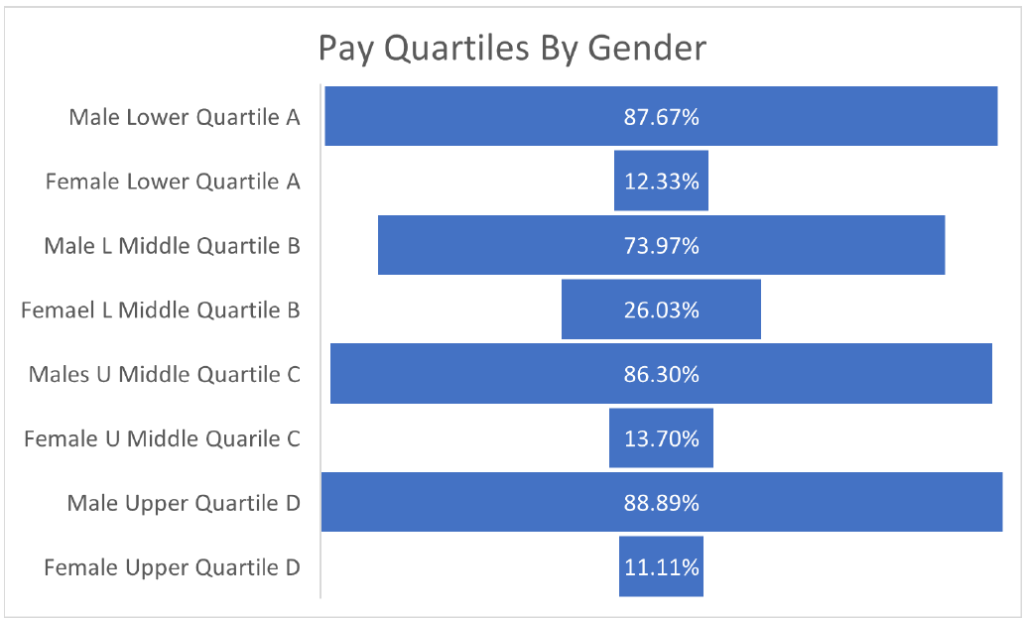
| Bands | What is included in these bands? |
| A | All Team Members whose standard hourly rate is within the lower quartile |
| B | All Team Members whose standard hourly rate is more than the lower quartile but the same or less than the median |
| C | All Team Members whose standard hourly rate is more than the median but the same or less than the upper quartile |
| D | All Team Members whose standard hourly rate is within the upper quartile |
Why do we have a gender pay gap?
Legally, men and women must receive equal pay for:
We are committed to equal opportunities and equal treatment for all Team Members, regardless of sex, race, religion or belief, age, marriage or civil partnership, pregnancy/maternity, sexual orientation, gender reassignment or disability. We have a clear policy of paying Team Members equally for the same or equivalent work, regardless of their sex (or anything else listed above). We:
We are confident that our gender pay gap is not because we pay men and women differently for the same or equivalent work. Instead, our gender pay gap is because men and women work in distinct roles and those roles have different salaries.
Across the UK economy, men are more likely than women to be in senior roles (especially very senior roles at the top of organisations). Men are more likely to be in technical and IT-related roles, which are paid more highly than other roles at similar levels of seniority. We trade in a very technical environment that will increase the likelihood of having impact on any gender pay gap.
Women are also more likely than men to have had breaks from work that have affected their career progression, for example to bring up children. They
are also more likely to work part time, and many of the jobs that are available across the UK on a part-time basis are relatively low paid.
This pattern from the UK economy as a whole is reflected in the make-up of our organisation. Most line managers and senior managers are men.
How does our gender pay gap compare with that of others?
The mean gender pay gap for the whole economy (according to the October 2024 Office for National Statistics (ONS) Annual Survey of Hours and Earnings (ASHE) figures) is 13.8%, while in the construction sector it is 11.7%. At 10%, our mean gender pay gap is lower than the whole economy and our sector.
The median gender pay gap for the whole economy (according to the October 2024 ONS ASHE figures) is 13.1%, while in the construction sector it is 15.5%. At 16%, our median gender pay gap is higher than the whole economy and our sector.
What are we doing to address our gender pay gap?
We are not happy with our median gender pay gap even though it compares favourably with others. We are committed to doing everything we can to reduce the gap. However, we also know this is a challenging task. For example, we have no control over what people choose to study or the career choices that they make.
So far, we have taken the following steps to promote gender diversity:
By themselves, none of these initiatives will remove the gender pay gap – and it may be several years before some have any impact at all. In the meantime, every year we will tell you what we are doing to reduce the gender pay gap and the progress that we are making.
Right now, we have plans to extend our evidence-gathering. We are asking for help to work out the barriers (and the drivers) for women form our Team Members.
Over the next year, we will:
Any further initiatives launched throughout the year will be reported on the company intranet.
I, Sandra Tyler, Head of HR and ER confirm that the information in this statement is accurate.
Signed
Sandra Tyler
March 2025