

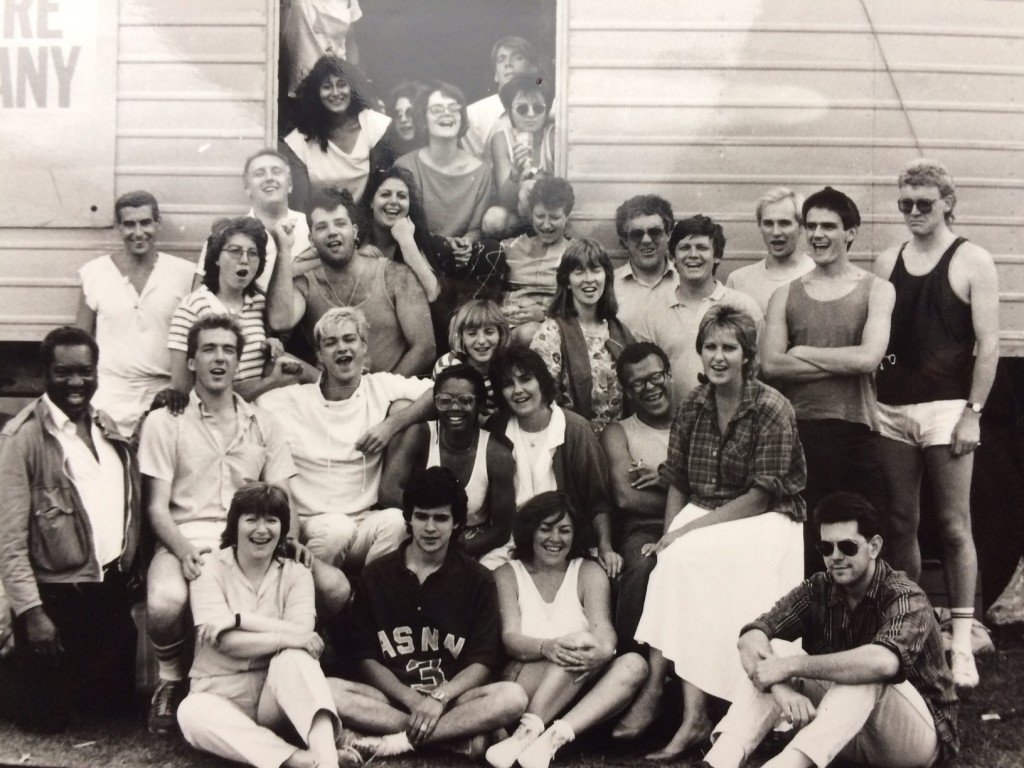
Johanna (third row, second from left) with London Bubble.
With Joe’s advice ringing in her ears, Johanna decided to look for a new job where she could make theatre again and immediately found one at the London Bubble where, aged 21, she began work as their Chief Electrician. She recalls: “London Bubble was a great experience for me. It essentially consisted of two tents – one was a bar and the other was a 100 seat performance space. We would visit parks across London and, in rep, perform four different shows over a week before taking it all down and moving on. There was a great camaraderie and it was a time when I’d make friends who I would know for the rest of my life”. It was also during her time with London Bubble that Johanna experienced what she calls “the true potential of theatre”. She comments: “By touring productions all across the capital, I saw how theatre could be about community and people. It made me an avid believer that theatre should be seen and enjoyed by as many as possible”.
This was only a summer job for Johanna though and the bubble soon burst (excuse the pun). She quickly moved onto her next endeavour – working for Opera 80 (now the English Touring Opera). Her Chief for the first year was a certain Hugh Vanstone (who’s Leading Light article can be read here). Johanna states: “Working with Hugh was great as he genuinely taught me a great deal. He was extremely ordered and showed me how to relight a show and what that entailed. It felt like I was moving on from simply playing with lights to genuinely analysing a designer’s work”.
Opera 80 toured all across the country and played everywhere from Sadler’s Wells to Carlisle Sports Centre. It would prove to be yet another learning curve for Johanna: “Wherever we visited, we had to use in-house kit. What this meant was I had to redesign the shows every single week to suit the particular venues. I had to think on my feet and really work within the limitations in front of me. In a way, it was better than a formal education as it was practical experience. That’s what I personally believe drama schools need more of. Theatre, especially lighting design, is a profession that you learn through practice as opposed to reading books. Also, by working, you get to meet some amazing professionals and make really useful contacts which stand you in great stead for the future”.
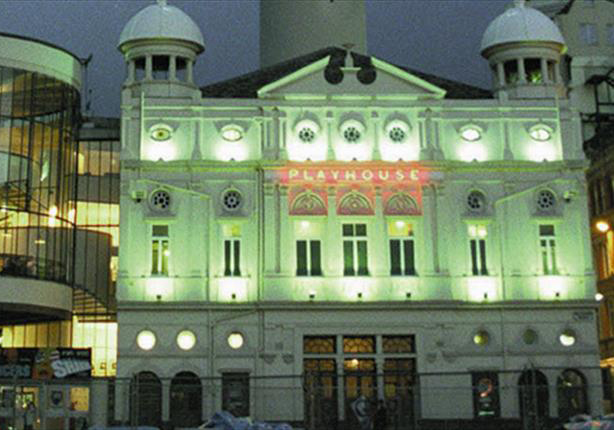
The Liverpool Playhouse where Johanna was Head of Lighting
After two seasons with Opera 80 in the winter and the London Bubble during the summer, Johanna was returning back to her North West roots as she accepted the role as Head of Lighting at the Liverpool Playhouse. This meant she would be lighting every show at the venue apart from the Christmas production and it’s a period which Johanna looks back on with fond admiration. She comments: “This was probably my favourite time during my entire career. I was literally able to experiment every month and try out ideas – from a new mad mix of colours – one of which is now used as an actual gel! – to experimenting with unusual light sources. I literally ‘had the keys’ to the building and could do whatever I wanted when I wanted”. This would often lead to Johanna becoming lost in her own world, experimenting into the night to the point where she would have to lock up by herself (she still firmly believes that the Playhouse is haunted). This period in Liverpool also allowed Johanna to grow as an artist, as she was able to test herself and push boundaries; including lighting a show in the theatre’s studio with just two lights! Johanna states: “Similar to the Royal Exchange, there was a real family feel to the Playhouse. Everyone knew one another and lived locally. We worked hard but played harder. It was also the first theatre where I had genuine support and a strong team of staff. Together we could really work to create something special”.
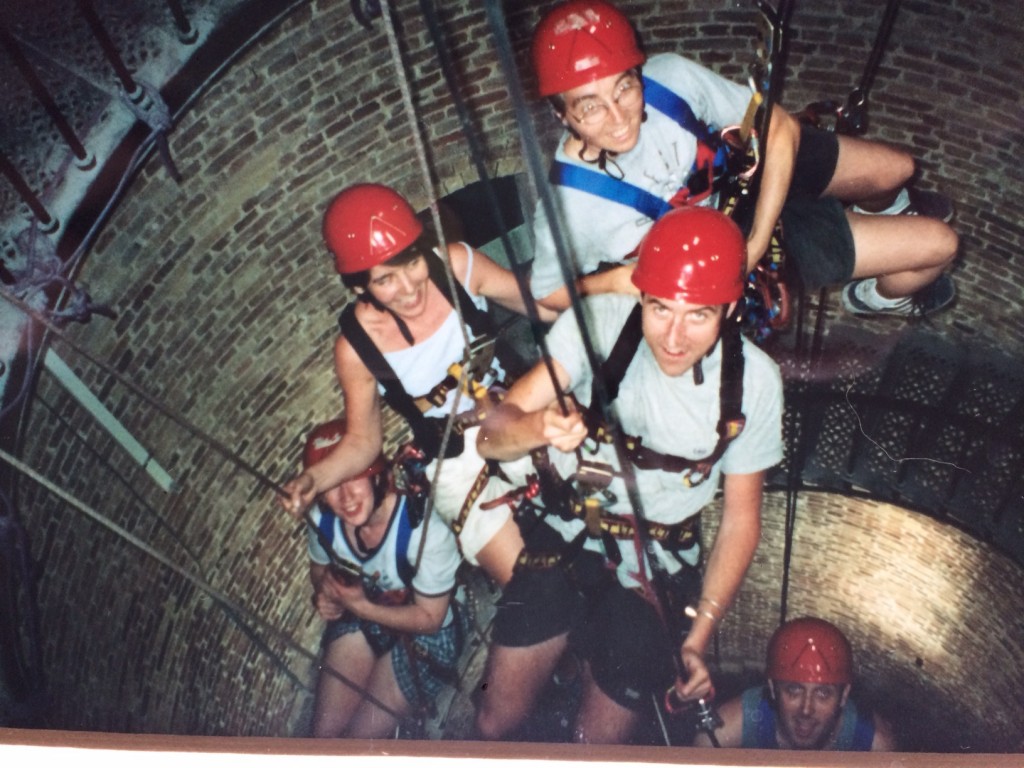
Johanna and co during her Royal Court days.
During her time at the Liverpool Playhouse, Johanna developed a reputation for being able to manage a technical team while simultaneously creating provocative, innovative work. So much so that when the position for Head of Lighting came up at the Royal Court Theatre in London, she was asked to apply for it. She recalls: “I actually missed the application deadline but I got a phone call to ask me to consider applying still. I did and for my interview, I had collated a full portfolio of design work. That said, they specifically told me that they weren’t looking for a lighting designer. So when I was offered the job, I initially turned it down as I very much wanted to focus on designing shows! Yet after several long conversations with the then Production Manager Bo Barton, I was persuaded to accept the position. Thanks to Bo’s insistence, I actually made the best move of my career. Initially I saw it as a short term move as the long-term goal was still to be a full-time lighting designer. 17 years later…”.
Johanna’s main role initially at the Court was to help maintain the building. In her spare time, she began to freelance on London’s fringe scene. In 1992, she worked on The Crackwalker by Judith Thompson at London’s Gate Theatre which starred Kathy Burke. It was a show that was to lead to Johanna’s big break. She recalls: “I was really happy with how the show went and it had received great reviews. Then one day Richard Wilson (best known for playing Victor Meldrew in One Foot in the Grave) walked into the Royal Court office saying he needed a lighting designer for a production called Women Laughing by Michael Wall that he was directing at the Royal Court Upstairs. He said he’d seen a show at the Gate where he thought the lighting design was very impressive yet he couldn’t remember the name of the play. When he started to describe it, I realised he was talking about The Crackwalker! At first I wasn’t sure if I should say anything. I then finally plucked up the courage to raise my hand and tell him it was my design! As soon as he heard that, he immediately offered me the role”. This was the start of a long collaboration with Richard, who called upon Johanna’s services for numerous shows, including seven more at the Royal Court and most recently Fracked! at Chichester Festival Theatre (which is about to tour the UK).
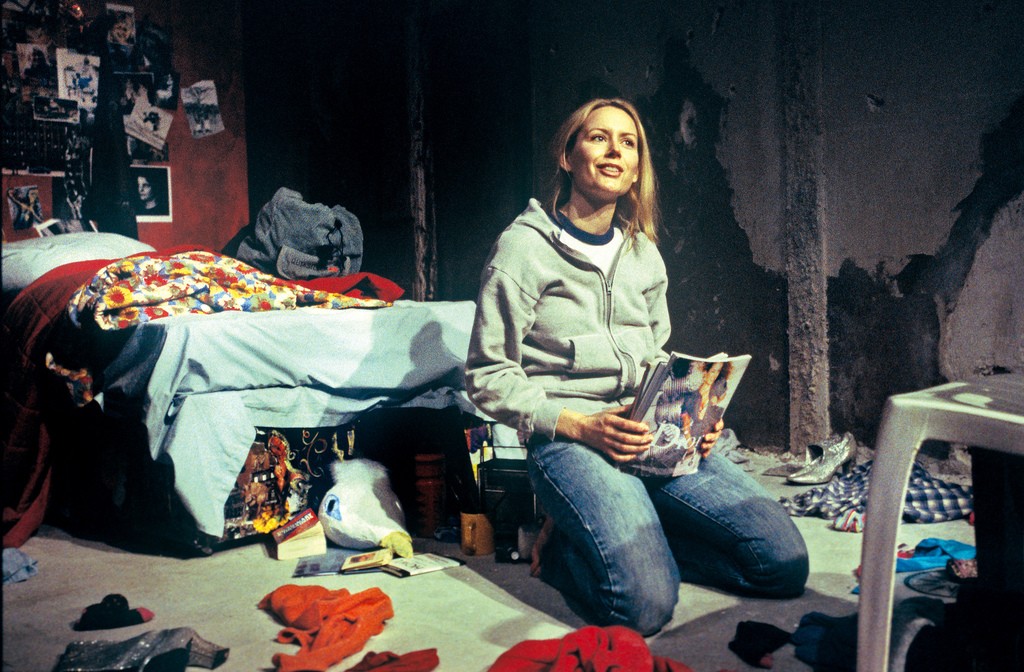
My Name is Rachel Corrie at the Royal Court Theatre, which transferred to the Playhouse Theatre in the West End.
Following her work on Women Laughing, Johanna began to light shows at the Court and during her time there would design more than 50 productions. During her tenure, she worked with four of the theatre’s most influential artistic directors: Max Stafford-Clark, Stephen Daldry, Ian Rickson, and Dominic Cooke. Of the various productions she worked on, she marks The Kitchen (directed by Daldry), Pale Horse (directed by Ian Rickson), The Steward of Christendom (directed by Stafford-Clark) and My Name is Rachel Corrie (directed by Alan Rickman) as her personal highlights. She comments: “Seeing how all of these directors worked was obviously a privilege as they create such provocative and memorable theatre. However what I really enjoyed was being part of the rehearsal process and watching how they all worked with actors differently and creatively”. Johanna was also at the Court during the late 90s when the venue was being refurbished and temporarily moved into two West End venues. Johanna states: “I was barely thirty and I was running two West End buildings split into three different venues as well as making a significant contribution to the design of both the main house and studio spaces at the new Royal Court. It was a great feeling to manage the lighting staff for three venues and oversea so many productions alongside designing a new building; especially at a time when theatre lighting technology was becoming so exciting. It was certainly a slightly surreal time in my career!”.

King Lear at the Royal Exchange which was broadcast on BBC Four
Similar to her predicament at the Liverpool Playhouse, Johanna eventually decided that she needed a new challenge and left the Royal Court in 2008. She comments: “It was definitely time to move on to pastures new. I’d had a brilliant time at the Court but I had only expected to be there for a couple of years. I wanted to move back into being freelance and to work on lighting a wider variety of shows, not just within one space. I told myself if I don’t do it now then I never will”. Johanna then went straight into lighting shows with directors she’d previously worked with. However, she was also very keen to work with up and coming new talent. She comments: “I told my agent that whilst I can work on bigger productions, it was important to me that I worked with younger directors who were just starting out in theatre. I’ve always found this inspiring; new younger directors and designers push you harder and make you look at theatre differently. It’s also important to remember that many of these people are the future of our industry”.
Over the next few years, Johanna found herself working on a whole host of shows. In the West End, she lit Dear Lupin, What the Butler Saw, Some Like it Hip Hop and Betrayal. She’s also ventured stateside to New York where she has lit productions of Haunted, My Name is Rachel Corrie and Guantanamo. She has worked extensively with Out of Joint theatre company and still works regularly with the Royal Exchange; her most recent credit there being King Lear, which was screened on BBC Four over the festive period. She comments: “Since leaving the Court, I’ve worked in some of the West End’s largest venues yet I have also lit shows for companies such as Pentabus who tour new writing in extremely rural areas that don’t normally receive theatre. I love the variety of productions I get to work on and the range of artists I get to collaborate with”.
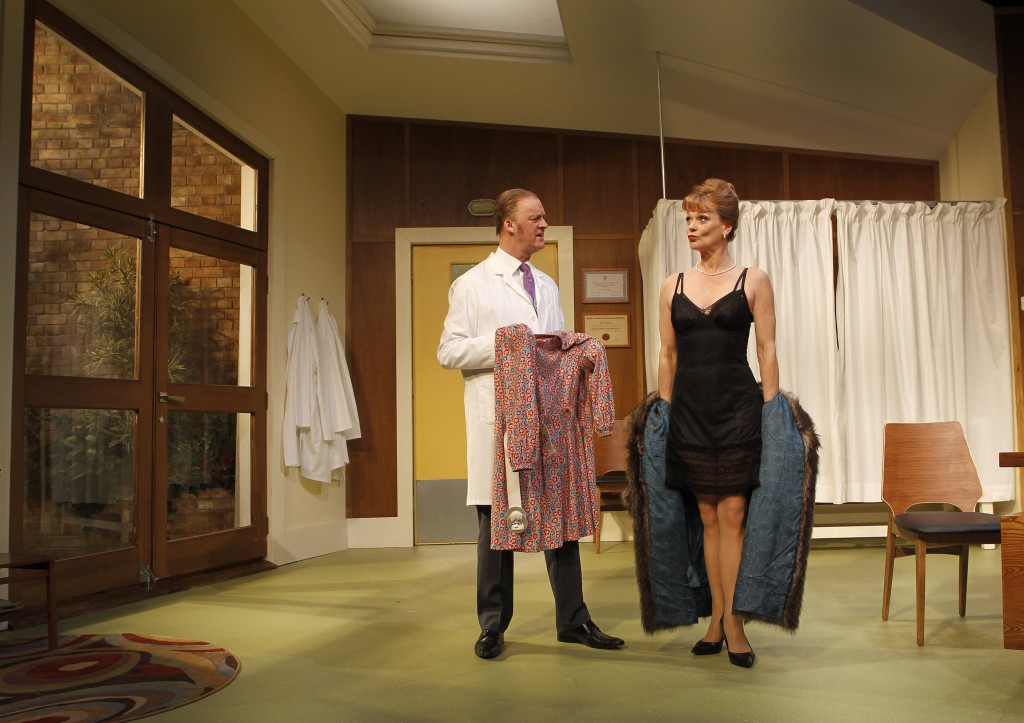
Samantha Bond and Tim McInnerny in ‘What the Butler Saw’ at the Vaudeville Theatre.
As one of the leading lighting designers with an extraordinary wealth of experience, it only makes sense for me to ask Johanna what advice she has for all the budding lighting designers out there. It’s almost as if she has her answer prepared: “Get out there and get involved. Work for people under any circumstance and ensure you’re gaining experience all the time. Similarly, see as much theatre as you can. I still think back to shows I saw at the Royal Exchange when I was a teenager so you should never underestimate the influence a show can have on you. It’s also very important to remember that this is an industry you need to be passionate about. If you’re not passionate about theatre then you won’t last five minutes”.
Our meeting is now drawing to a close and Johanna has to go prepare her next show The Star which she’s working on at the Liverpool Playhouse of all places. As we depart, I cheekily ask at what age she thinks she’ll eventually stop focusing lights and start putting up her feet/hitting the fairways; especially considering the fact that she’s achieved positions and accolades that most budding LDs could only aspire towards. She comments: “I can’t imagine myself ever retiring. I know non theatre friends who are literally counting down the clock, waiting to retire. That’s not me. I want to work forever and keep pushing myself and creating original designs until I can’t anymore”. And from what I’ve gathered in my two hours with Johanna, that certainly won’t be any time soon….
Photos courtesy of Joel Ryan, Johanna Town, John Burke, Jonathan Keenan, Stephen Cummiskey, Visit Liverpool and Yvonne Arnaud.