

Leading Light with…Peter Mumford – Part One
Comments Off on Leading Light with…Peter Mumford – Part One
Peter Mumford
Our Copywriter Adam went to meet Peter Mumford…
It’s a blistering morning as I exit the tube at Sloan Square Station. Thankfully I only have to make the short walk to the Royal Court Theatre as it is here I am meeting Peter Mumford, one of the most renowned and respected lighting designers in the industry. Having just finished lighting the dazzling 42nd Street at Theatre Royal Drury Lane (you can read his interview here), Peter is now lighting The Ferryman which has just opened at the Royal Court Theatre to a multitude of five star reviews. Before he prepares for its transfer to the Gielgud Theatre, he’s managed to take some time out of his busy schedule to take part in this month’s Leading Light.
In what’s now become somewhat of a cliché with Leading Light, we start at the very beginning. Peter’s story begins in London, or more specifically Sutton. He recalls: “I was raised in the suburbs in what was not a particularly theatrical family. My mother was a primary school teacher whereas my father was a gas showroom manager”. Whilst his family might not have worked in the industry, they still had an interest: “Both my parents became involved in amateur dramatics after the war. I remember being taken often to Wimbledon Theatre which wasn’t that far from where I lived. The first thing I recall ever seeing on stage was Peter Pan at the Scala Theatre, which was ultimately demolished in 1969. I was just nine at the time and still remember images from the show and I think it may have been Margaret Lockwood playing Pan!”.
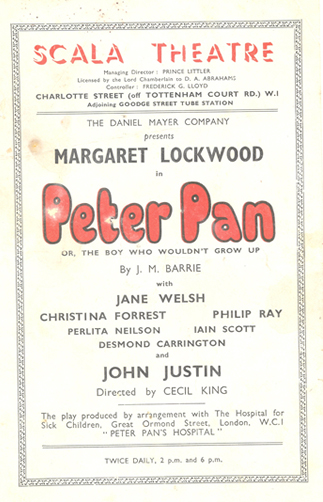
Peter Pan was Peter’s earliest theatrical memory.
At secondary school, Peter became heavily involved in the art department and studied the subject at A Level. He recalls: “I really enjoyed Art and come the age of 15/16, I began helping out on school theatre productions where I would help design the set. I will always remember visiting my Careers Master and not having a clue what I wanted to do. The only two things that seemed relatively palatable were maybe a journalist or graphic designer – to which my Careers Master said he couldn’t stand either artists or journalists!”. Yet this didn’t deter Peter and he would go on to study at the Wimbledon School of Art. It was here he undertook a pre-diploma course where he studied “a bit of everything”. During this time, he would continue to see shows and work on college productions in the capacity of set designer. For a while, it seemed as if set design would be Peter’s calling as, once he finished at Wimbledon, he went to Central School of Art to study Stage Design under Ralph Koltai – a decision that would prove to be life changing. Peter states: “That first term at Central had a huge influence on me; particularly under the guidance of Ralph. We did a lot of work at the Cochrane Theatre which was a part of the Central School of Art building and Ralph would bring in all of these amazing directors and designers who he was involved with on his own projects. As a result, we got to work with people such as Charles Marovitz , Clifford Williams and John Bury, along with lighting designer Brian Benn who gave a lecture course in lighting which Ralph Koltai was very involved in. At the time there were no dedicated lighting design courses and indeed only three stage design courses throughout the UK. In retrospect, I realise just how fortunate we were to have immediate access to such influential individuals and the experience of those projects remains a great inspiration”.

Ralph Koltai was a huge influence during Peter’s studies.
During this time, Peter found himself seeing more and more shows, allowing his passion for theatre to grow. He states: “I was seeing a lot of shows – around three a week. I was slowly becoming obsessed and soaked up whatever I could. It was a time when Laurence Olivier was leading the National Theatre and Peter Brook was directing at the RSC so I was able to see the many famous productions of that time”. It was during these years that contemporary dance began emerging in Britain; an art form that would hugely influence Peter: “I was immediately fascinated by contemporary dance. I was lucky in the sense that Ballet Rambert’s London base was the Cochrane Theatre where annual collaborations with the design students and young choreographers took place. Norman Morris, the then artistic director of Rambert, led several projects within the design school which again furthered my interest in contemporary dance”. Peter continued studying for his diploma and soon found himself in his third and final year (“there were only seven of us left by that point!”). To make some money alongside his studies, Peter began working as a stagehand at the Palladium theatre. His first professional gig? “I remember it was in 1968 and I was paid to sweep the confetti from the stage in the original production of Hair!”. So not to interfere with his studies, Peter would work evenings and was paid a modest £5 a week, noting that you “got paid more if you wore ‘blacks’ for the in view scene changes”. And whilst this was initially seen as a way of earning some extra money, it actually proved to be another form of training. Peter states: “What my stagehand experience showed me was how all aspects of the theatre worked. I got to see the importance of every role – something which would prove extremely useful in my later career”.

Peter’s first paid job in theatre was sweeping up confetti on the original production of Hair in 1968.
Having gained his diploma, Peter entered the working world on a full-time basis and continued to assist at the Palladium. He states: “While I was working at the Palladium, Geoff Moore (then a young emerging director) was also working there at the same time. He told me that he was setting up his own company called Moving Being on the back of a commission from the newly created I.C.A. He asked me if I wanted to come on board and I jumped at the chance”. Moving Being was formed in 1968 and was known as an “experimental mixed media theatre group” incorporating text, film, projections and music with contemporary dancers and actors. The first project Peter worked on was a Festival in Berlin called London Now in Berlin. Peter recalls how they literally “threw everything in the back of van and hit the road”. However, Peter wouldn’t be hitting the road any time soon as he stayed with Moving Being for more than ten years. He recalls: “My role at the company was Set, Projection and Lighting Designer (effectively Technical Director). Essentially my work encompassed all of the visual elements which were vital in every show. The role also acted as my first real introduction to using lights. While using early projection equipment (nowhere near as bright as today!) I soon realised that this required lighting control as well, so lights began to play a much greater role in my artistic output”. Peter left London to move to Cardiff where the company was based and it would be his home for the next twenty years at least. He states: “We were fortunate in the sense that we received financial support from the Welsh Arts Council who were always very encouraging of our work. We were based at the Chapter Arts Centre in Cardiff which was an old school converted into an arts centre. He recalls: “Working with that company turned out to be a huge learning curve and was very formative for me. It was a huge influence on all of my work from there on.”

The original Moving Being company. Guess which one is Peter…
Peter stayed with the company until 1978 when he decided to move onto pastures new. While he continued to work with the company on individual projects, he found himself working on more and more shows as a freelancer; in particular dance productions. He states: “Following my extensive work with Moving Being, I naturally became involved with the contemporary dance world, teaching design and lighting at London Contemporary School of Dance at The Place in London. What’s important to remember is that, with a lot of dance and choreography, there was often no real set as such, hence light has to play an important role within the space. It has to become a part of the piece and takes on a much more scenic role”. During this time, Peter found himself lighting a lot of Siobhan Davies’ work along with many pieces with Richard Alston whilst he was artistic director of Rambert in the 80s. He marks these as two of the most important and influential creative relationships in his career. His continued involvement in dance saw Peter lighting many various dance works with several different choreographers around London, mainly at The Place Theatre but also at Sadler’s Wells.
In 1982, Peter became a founding member of Second Stride Dance Company, along with Richard Alston, Siobhan Davies, Ian Spink and designer Antony MacDonald. Although the company was only supposed to run one season, their combined expertise and critically-acclaimed work saw them continue for some 15 years. Peter states: “I was very proud to be part of Second Stride – particularly during such an exciting time. It was an accumulation of the previous collaborations and productions I had worked on and it felt like what we were doing was creating innovative and profound dance pieces”. Across this period of time, Peter’s work also evolved into the opera world and whilst he continued to design sets from time to time, the emphasis had moved more into the area of lighting design.