Leading Light with…Jason Taylor – Part One
Comments Off on Leading Light with…Jason Taylor – Part One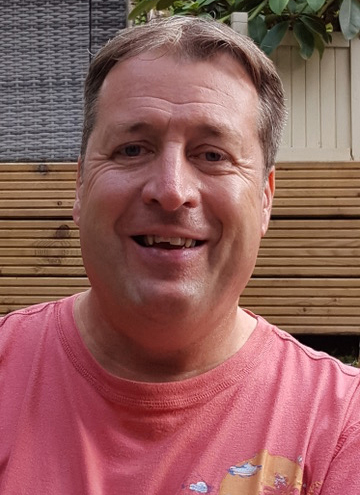
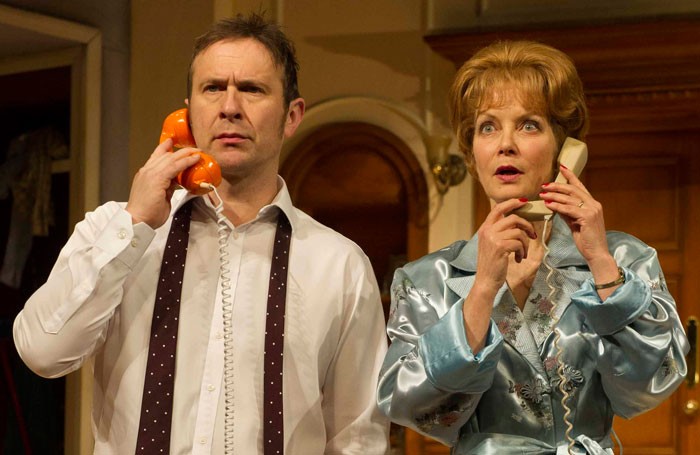
Lighting Designer Jason Taylor
Our Copywriter Adam went to meet Jason Taylor…
It’s a busy morning as I attempt to make my way along Charing Cross Road. Steering my way strategically between tourists and pedestrians, I eventually find myself at my chosen destination: the Garrick Theatre. The bright red posters adorned outside indicate that the next show to open is David Walliam’s Gangsta Granny. Looking down the list of credits on the main poster, I notice that it states Lighting Design by Jason Taylor; and that’s just the man I am here to meet today.
Jason is a somewhat unique entry in the Leading Light series as, unlike the others I’ve spoken to, it seems that theatre played a significant role in his life from as early as he can recall. He states: “I was born in Oldham, Lancashire, and I came from an extremely theatrical family. My father is Kenneth Alan Taylor, former artistic director of Nottingham Playhouse, whereas my mum is Judith Barker who played Janet Barlow in Coronation Street for 8 years and has just been in Stepping Out at the Vaudeville Theatre so you could certainly say I have the entertainment industry in my blood!”. Jason’s parents met when his mother was in rep at Oldham Coliseum where his father was a director. This was during the days when a company of in-house actors would perform a different show each week. Due to his parent’s profession, Jason would often find himself in theatrical surroundings; which is where he can trace his passion for lighting back to. He recalls: “I remember from around the age of six, I would be sat in the auditorium at Oldham and just fascinated by the beams of light that would hit the stage. It really had a huge impact on me very early on”. However, this huge impact was to land Jason in a spot of trouble: “I must have been about ten and I remember my mum was playing Mother Courage in a show. However, I didn’t think the lighting was particularly good so I went into the auditorium during a show with a torch and shone it directly at her. Safe to say the crew, in particular the lighting designer, weren’t very happy!”.

Jason is his very early days…
Somewhat inevitably, theatre became a major interest for Jason growing up. He comments: “I wasn’t particularly sporty nor did I have any other main hobbies apart from theatre. My sister and I were just immersed in this world and it was literally all we knew. My dad built me a model theatre where I essentially had to create the sets themselves (in miniature, of course). I remember building the sets for Oliver and then re-enacting the entire piece with the cast album playing next to me on the vinyl record player. I would perform all the scene changes and alter the lighting colour using sweet wrappers. You could say that was the first big musical I designed!”. When I ask Jason about his memories of school, his enthusiasm quickly wanes: “It was alright. The school I went to was literally round the corner from the Oldham Coliseum where my dad was Artistic Director at the time. I remember being sat in class wishing I was in the theatre instead. I was just eager to get stuck in; so much so that when I was 14 I was already working the followspots”. Unsurprisingly then, when the summer holidays came, Jason found himself virtually living in the theatre. He recalls: “During the summer, and when the theatre had some ‘downtime’, I found myself doing all of the maintenance jobs. This included such glamorous tasks as cleaning Patt 223 lenses and servicing 264s! Strangely enough, I really enjoyed doing it. I also knew by this point that I really wanted to pursue a career in lighting”.
Jason left school at 16 and immediately went to the Royal Exchange in Manchester to join the stage crew: “That was interesting as I was only about five foot four and extremely scrawny. However my passion and desire to get stuck in overcame any physical struggles I had”. During his time here, Jason learned of a programme that the Royal Exchange ran called Theatre’s Own Training, which was in conjunction with the ABTT. He states: “It was the same one that Jo Town did, except she was two years ahead of me (you can read her Leading Light here). So when I arrived, Jo was just finishing the last year of her training”. Jason started on the crew but knew his actual passion lay with lighting and he was desperate to embark on the training. He states: “I started badgering the Chief LX saying I want to do that. To my delight, aged 17, they took me on. Sadly, the funding collapsed as the ABTT lost some of theirs. Thankfully the Exchange then paid for it themselves; something for which I’m eternally grateful”. By this point, Jo had completed her training and become assistant. Mirroring Jo’s path, this was a role that Jason would also fulfil following his training. He recalls: “During this period, not a lot of regional theatres had lighting designers who were visiting them on a regular basis. Thankfully, the Royal Exchange did. I learned a lot from simply observing designers at first before plucking up the nerve to ask if I could plot for them. One of my earliest memories was when Nick Chelton came in and did a couple of shows. Brian Harris also visited a few times. I was very fortunate to be surrounded by such established people and it was a great time to learn”.

Jason’s parents Kenneth and Judith came from a theatrical background.
Jason decided to leave the Exchange when he was 19; something he describes as a conscious decision: “I always knew there would be limited design opportunities there. As there were lots of visiting shows with their own LDs, it was difficult to break through on the design front. Also, as the Exchange job was so full on, I didn’t even have time to light shows on the side which is what I really wanted to do. My secret dream was to move on and only come back to light a show – something I was able to achieve”. Upon leaving Manchester, Jason moved to Nottingham where he became Deputy LX at the Nottingham Playhouse. The move was driven by the fact that Jason knew there would be more lighting opportunities over at Nottingham – something which would prove to be true: “Effectively, a year into the job I became their Resident Lighting Designer. The first show I lit there was the stage adaptation of Kes. It was a great experience as I had to learn very fast. We were doing a show every three weeks so you’d open on say a Wednesday or a Thursday and then the following Monday it would be straight into rehearsals for a new show. You had to work quick and I think I’ve taken this skill throughout my career of having to think fast and get on with it, as opposed to having endless discussions”. Nottingham would also offer Jason his West End lighting debut – at the tender age of 20. He recalls: “My first West End show was Rosencrantz and Guildenstern. It started at the Playhouse before transferring to the Piccadilly Theatre in London. I had literally gone from working as part of a crew to lighting a show in the West End in the space of a few months – it was certainly a surreal experience!”.
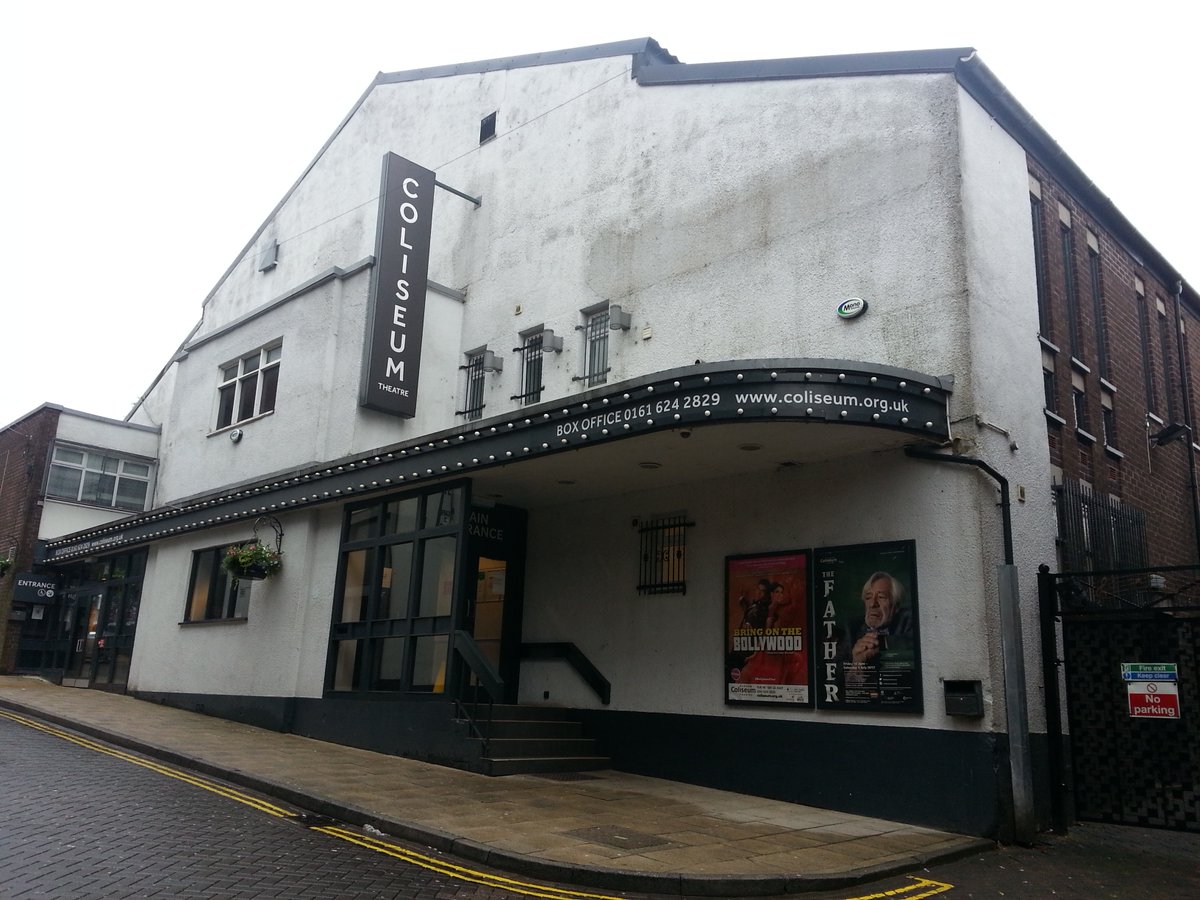
Oldham Coliseum would offer Jason his first taste of theatre.
Along with career opportunities, Nottingham also provided Jason a fresh approach to lighting his shows. He states: “Before joining Nottingham, I hadn’t really learned the theory of lighting design and studied what this was. I had copied things I’d initially seen and tried to replicate tropes. At the Playhouse, this gave me the opportunity to experiment and learn from my mistakes”. While Jason swears this was invaluable for his own development, he believes that similar opportunities are no longer available today: “The problem is that the chances to get it wrong and learn from this simply aren’t there now. There are a lot of large regional theatres, such as Nottingham, that don’t have any in-house opportunities. That said, this isn’t all down to budgetary factors. Rather, lighting design has achieved a much higher status in recent years. Lighting design, and general lighting jobs in theatre, have become much more specialised – to the point where you have individuals who are experts in their fields. Back in the day you used to have a production electrician who would just do some lighting on the side hence they could play around with certain techniques”.
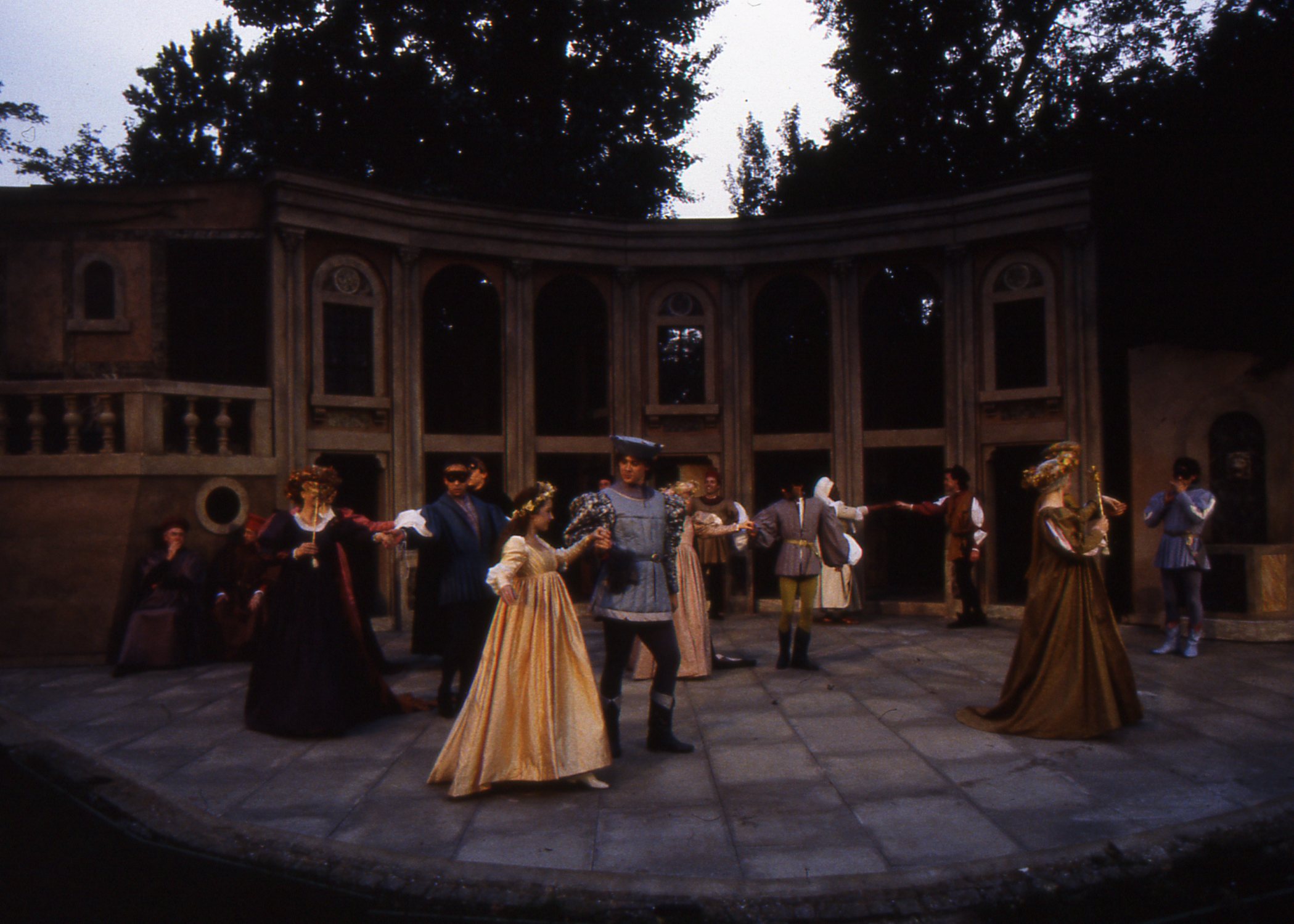
Romeo and Juliet at Open Air Theatre. It was directed by a certain Judi Dench.
Jason was in Nottingham for four years and left aged just 23. He comments: “I felt at this point that the next natural step was to go out and be a freelance lighting designer. So I left, expecting to be inundated with opportunity after opportunity. Imagine my surprise when I then hardly worked for 12 months!”. Jason remained in Nottingham during this time yet a move to London was soon to be on the cards. He recalls: “I got offered an amazing gig at the Regent’s Park Open Air Theatre from a director called Caroline Smith who I’d worked with in Nottingham. The year was 1990 and the show as Julius Caesar. It went really well and I was very proud of my design. The then Artistic Director Ian Talbot came up to me afterwards and asked if I’d come back next year. I of course said yes. However, I was quite surprised when he said he didn’t just want me to light one show but the entire season!”. And it wasn’t just the 1991 season that Jason returned for. He would go on to light the next twenty and work on productions such as Romeo and Juliet, directed by Judi Dench, Richard III, directed by Brian Cox, and Hamlet, directed by Tim Piggot-Smith.
During his time at Regent’s Park, Jason would see the theatre transform rapidly: “When I first started, the theatre was very basic. It was literally a raised stage and a seating block with four lighting positions and some rickety scaff towers left and right, along with a handful of battered, rusty par cans. Very slowly, year on year, they managed to build this up (I remember the first time we bought 12 x waterproof scrollers and how impressed we were!). In 2000, we received National Lottery money so more technical facilities were added and more money spent. As a result, I felt like I took the venue on a journey and really saw it grow”. Jason’s first season at Regent’s Park also marks the first time he lit outside. He comments: “I think of lighting outside as creating broad brushstrokes. It’s not something you can do subtly and you need to accept that you can’t fight the elements of daylight. That said, I remember one director on a production of Macbeth saying I need you to turn daylight into night. When I said this was physically impossible, he couldn’t comprehend why not. To this day, I’ve still not found a fixture that’s capable of this…”.
Click here to read Part Two.