Leading Light with…Charlie Morgan Jones – Part 2
Comments Off on Leading Light with…Charlie Morgan Jones – Part 2
3am at Leicester CURVE was Charlie’s first professional production after graduating.
Charlie graduated and was left to find his own way in the big wide world. It was here where his work at the Vaudeville would prove useful: “I emailed every single producer I knew, along with all the DSMs I’d worked with from my time at the Vaudeville. They were hugely supportive and told me who to get in touch with. It was in those early stages that I’d take unpaid leave to go and work on shows on the London fringe. It was a case of slowly, but surely, getting my name out there”.
Charlie’s first show out of university was 3am for the Curve Young Company at Leicester’s CURVE Theatre. He recalls: “I was put forward by Rachel Nicholson who was the Head of Creative Lighting Control and was immensely lucky to go straight into a show like that. I really felt like a ‘professional lighting designer’ as I had a programmer and stage management team”. Charlie would the continue to work wherever he could. He recalls: “I did a show at the Edinburgh Fringe called Jump which was a brilliant experience. I also lit a show at The Met in Bury and remember just jumping on a train, heading up to Manchester and saying ‘I’m here to light your show’. At that age, you just turn up and hope for the best. Then again, you need to have that go-getter attitude as people are only willing to employ those with experience and that was something I needed”.
It wouldn’t be long until Charlie got what he considers to be his first ‘big break’: “I worked on Dialogues des Carmelites at the Birmingham Conservatoire and the Director was Michael Barry. I was at his house for dinner and he showed me a prop from the Ring Cycle which he recently directed. As I knew very little about him, I presumed it was something he’d worked on at the Birmingham Local Opera. Fortunately I didn’t say anything out loud as Michael quickly informed me that it was a show he’d worked on at the Royal Opera House! A quick Google under the table and I realised he was quite a big name! We got on like a house on fire and Michael recommended me for various jobs including the Polish National Opera”. It was also at the Conservatoire where Charlie met Jack Ramplin who Charlie has used on lots of shows as his Associate. Charlie comments: “Michael foresaw a long creative relationship between Jack and I – he wasn’t wrong!”.
Charlie’s second ‘big break’ was to come shortly after at the Duchess Theatre in London’s West End. He recalls: “I was asked to light Cool Rider, which is the sequel to Grease. It was an all-singing, all-dancing musical with so much happening all the time – the first number had 80 lighting cues! For this show, I worked with an Associate called George Smith who was fantastic to bat ideas around with. It really changed my way of working and brought out the best in my lighting”. Shortly after this, Charlie and George formed Smith+Jones LX. Charlie comments: “We became friends but he sadly (for me) lives out in Macau now for work. That said, we’re still as close as ever, and I always visit him when I go to the Far East for work”.

Charlie lit Cool Rider at the Duchess Theatre in London’s West End.
The third break of Charlie’s was Avenue Q; the puppeted musical which is also one of Broadway’s longest running musicals. Charlie recalls: “I had worked with production company Selladoor Productions in their early days and remember touring Ibsen’s Ghost in the back of a van. They asked me back to light Avenue Q which was doing a three week run in Greenwich in April 2014. The run sold really well and got a lot of people talking – so much so that it turned into a six month tour. It then returned for a second tour in 2015, a third tour in 2016 and it’s recently been announced that it’s coming back next year. It was one of those shows that just ‘became a thing’ – when I told people I was lighting it, they were really impressed. It also got me an agent and opened so many doors for me as people were now able to see my work”.
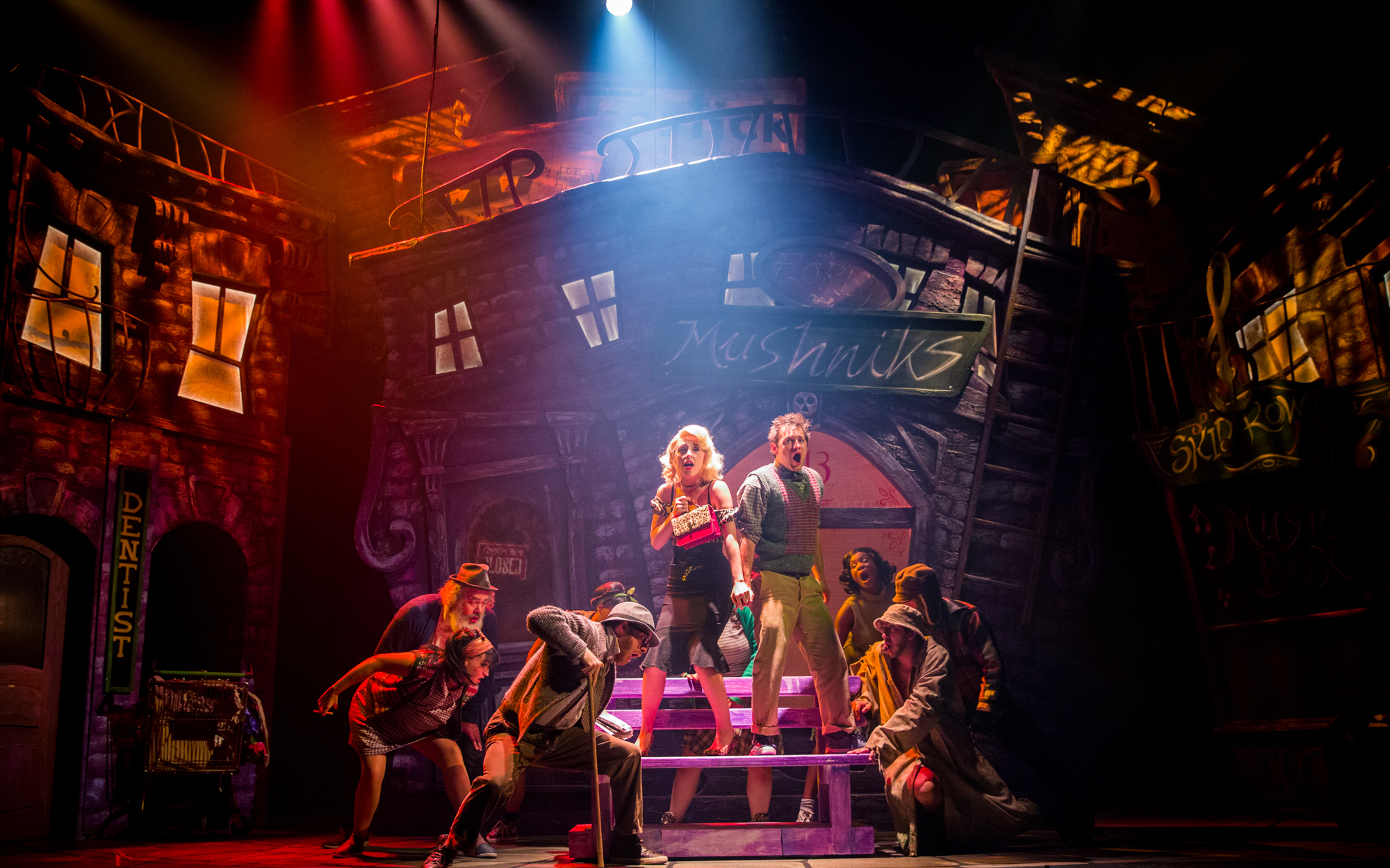
Little Shop of Horrors is a personal highlight for Charlie.
Whereas these are Charlie’s ‘big breaks’, I ask him if any other shows that standout. Safe to say, he has a fair few: “Little Shop of Horrors definitely sticks in the mind. Everything on this production just felt ‘right’ and all the creatives just clicked. We wanted the show to be zany, cartoony and over the top; similar to the feel of the film. I remember being sat in tech thinking this should be spectacular and it was. It was great to be a part of and the highlight was when it visited the New Theatre in Cardiff where I used to see shows as a kid. It was at that point when I was confident in telling people that I was a lighting designer”.
Other shows include Derren Brown: Underground which Charlie describes as “incredibly bizarre as it was a huge name and another show that everyone knows and recognises. It’s also amazing that it’s going to the Wales Millennium Centre which is where it all started in a sense – I can’t wait for mum and dad to see it!”. The Polish National Opera is another highlight of Charlie’s. He recalls: “I was the only non-Polish speaker so it was the case of being thrown in at the deep end. That said, I spent a lot of summers in Poland as a child and can understand the basics so was able to communicate with Mariusz the director”.
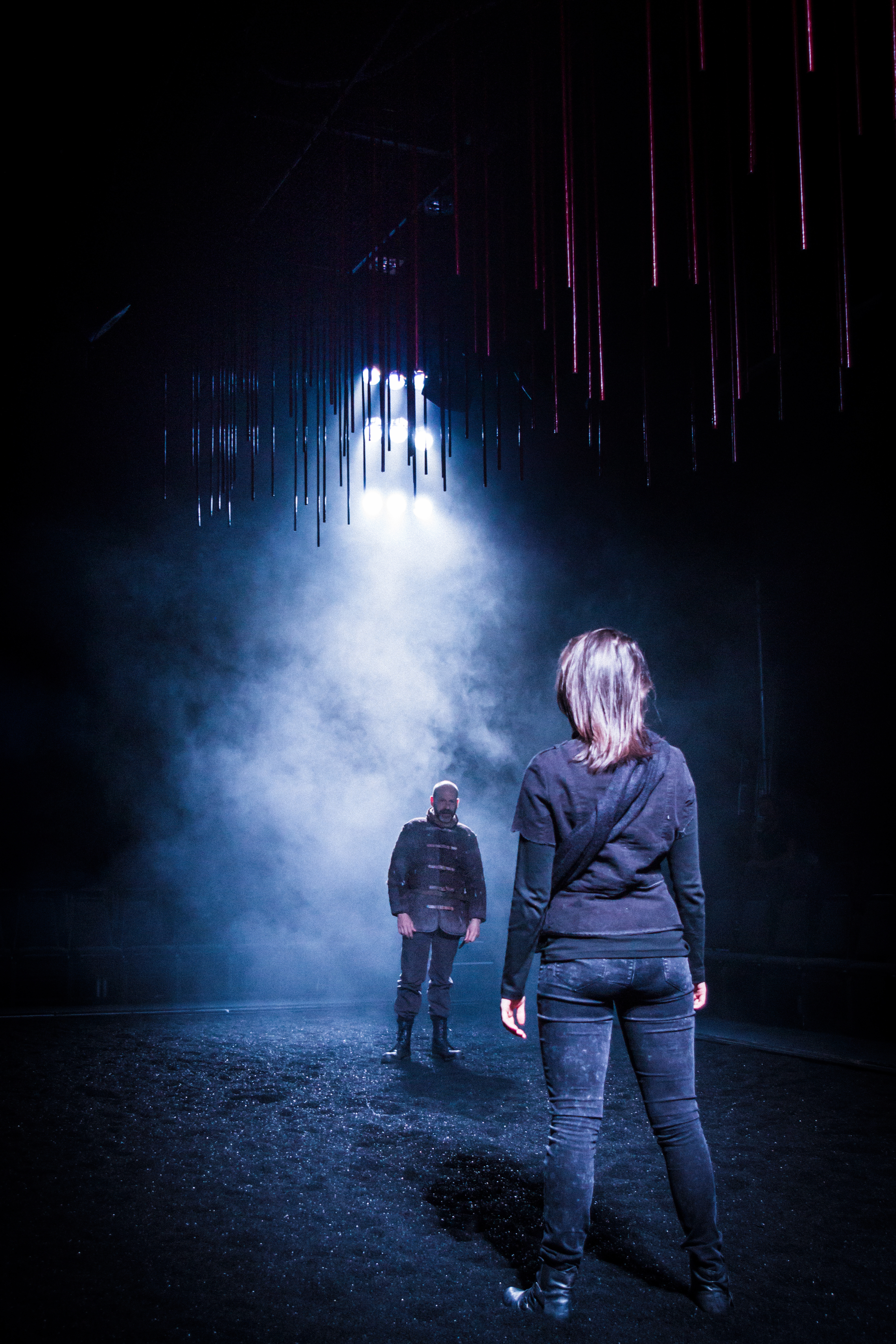
Macbeth at Theatre Severn was lit by Charlie.
Charlie has managed to achieve a lot in a short time and, while it’s largely down to a hard-working ethos, he has been lucky enough to have the support and influence of some lighting legends. He comments: “As part of my drama course at college, we went to see the National Theatre’s The Caucasian Chalk Circle which Paule Constable had lit (you can read her Leading Light here). I actually phoned my dad during the interval saying how amazing I thought the lighting was; it was a character within itself. Almost without realising, Paule had become an influence. Flash forward a few years and I was back at the Millennium Centre working in between uni terms. It was 2010 and I was followspotting on the new Les Misérables which Paule had lit. When I was back in Wales, I went over to the production desk and said hello and she was just the most approachable and friendly person. We went out for lunch and she told me everything I needed to know about lighting. Another person who’s been a huge help is Rick Fisher (you can read his Leading Light here). During my second year at Bruford, he gave a talk and was kind enough to give me his email address. I emailed him that night (very eager!) asking if I could come and work with him on a show. He was lighting The Fantasticks at the Duchess Theatre and I sat behind Rick and the programmer and learned so much. I even got credited in the programme as Assistant to the Lighting Designer! Ultimately, both Paule and Rick are incredibly talented and equally kind individuals and I also show the same level of support to anyone who approaches me for advice”.
Listening to Charlie talk about his journey and career, it’s easy to forget that he is still extremely young (not even 30). So what aims does he have for the future? He answers: “When I was 14/15, my main aim was to solely light West End shows. I’ve now had eight productions in the West End so my goals have changed slightly (as they should). I would like to light more dance and would definitely like to work at the English National Opera. I think it’s important to remember that the role of lighting designers is changing also. It’s no longer just theatre. For instance, last year I was asked to light the rainforest at the Eden Project – something I never thought I’d do. Ultimately, I want to continue my existing relationships with current designers, directors and production companies as well as push myself as a designer”.
If the last few years are anything to go by, it’s safe to say that Charlie will continue pushing himself and cement his reputation as one of the most exciting lighting designers this country has to offer.
Photos courtesy of Graeme Braidwood, Hywel Jones, Matt Martin, Pamela Raith, Rose Bruford College and Sven Worrow.