

White Light Supplies Evita at Regent’s Park Open Air Theatre
Leave a Comment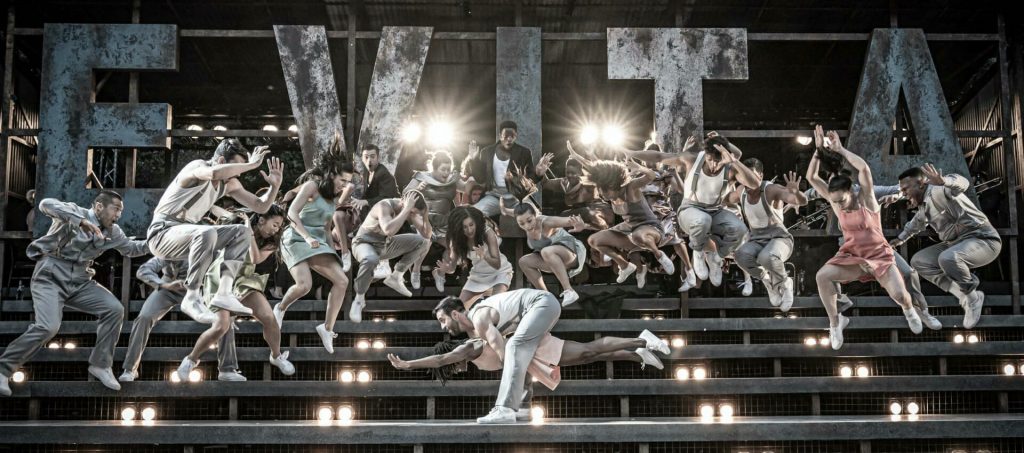
White Light has once again supplied the lighting equipment for the entire Regent’s Park Open Air Theatre season, which recently culminated in a revival of Tim Rice and Andrew Lloyd Webber’s iconic musical Evita.
Established in 1932, Regent’s Park Open Air Theatre is one of the largest theatres in London. Situated in the beautiful surroundings of a Royal Park, both its stage and auditorium are entirely uncovered and every year it hosts a season of bold and dynamic productions. This year was no exception, with productions of Our Town, Hansel and Gretel and A Midsummer Night’s Dream all achieving critical acclaim. The final show of the season was Evita which was directed by Jamie Lloyd, designed by Soutra Gilmour and lit by Oliver Award-winner Jon Clark.
Jon explains: “Soutra and Jamie chose to set Evita on a dilapidated seating bleacher, which to all intents and purposes looks as though it may have been sat in Regent’s Park for the past eighty years! We wanted to make a direct connection between the outdoor environment and the production; one being informed by the other. The suggestion of a sports stadium echoes the environment of dictatorial political rallies of the past, which has a resonance with themes of Peronism highlighted in the production.
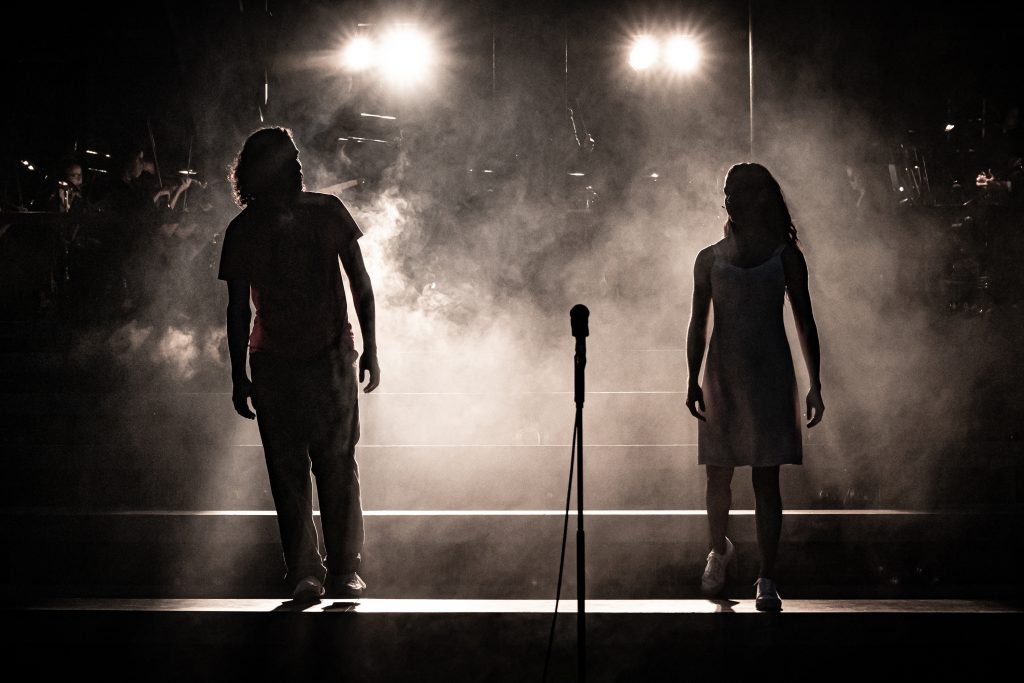
He continues: “Jamie was keen that the production and lighting design harnessed the dynamism and energy of an outdoor music festival. We were particularly drawn to Beyonce’s iconic performance at Coachella last year. Contrasting with the music festival aesthetic is a starker, directional lighting language, more synonymous with contemporary European opera”.
To achieve his design, Jon approached the WL Hires team, who have looked after the Regent’s Park Open Air Theatre all season.
The lighting in the show plays with the tension between open white tungsten Par Cans and colder LED and Arc sources. The set comprises of eight wide steps rising from the front of stage which is unapologetically rectangular in its form. The key lighting positions are informed by this and much of the functional light is delivered as uplight, travelling up the rake of steps.
Jon explains: “We utilised the new GLP Fusion Stick 10s as the cold uplight source, which provides an intense controllable light in a very discreet sized unit and contrasts with a line of Par 64s in the same position. Upstage, nestled into the roof of the band structure are more Par 64s, arranged into clusters, which run the width of the set. This time the Pars contrast with two continuous runs of GLP Impression X-BAR 20s which describe the architectural form of the set and provide a colder, more dynamic look. Built into the risers between each step are 56 2-Cell Molefays, which act as blinders and are intended as rock n’ roll inspired abstraction of the classic Broadway 42nd Street aesthetic. They’re also used to evoke the feel of Evita arriving in a big city for the first time in the Buenos Aires number and create energy at other times. Under the set, the tungsten Molefays contrast with two banks of Martin Atomic LED Strobes and SGM X5 LED Strobes, which are used as intense and constant flood sources.
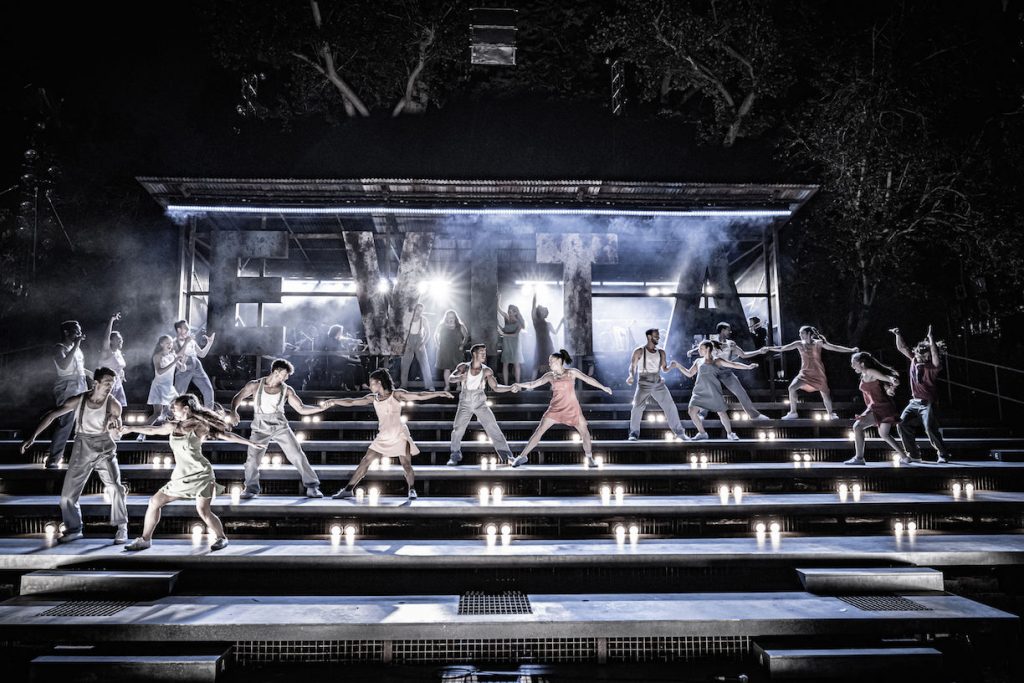
Jon continues: “From the outset, I wanted to create a much higher backlight position than is normally achievable at the Park. Adam Squires and Andy Beardmore at the Theatre did a fantastic job of sourcing two 14m high truss towers, which enabled us to create two key backlight positions upstage of the set, nestled amongst the trees. Each tower supports a solitary MAC Viper Wash DX, utilised at various moments as a pseudo backlight follow spot, to suggest the scale of a stadium and to heighten the dictatorial protagonists. These are all key to delivering the final image of Evita, extracted from all that has gone before”.
The show has now opened to critical acclaim and marks yet another successful season at Regent’s Park. It also marks a very busy summer for Jon who is currently working on the Broadway transfers of Pinter’s Betrayal (also directed by Jamie Lloyd) and The Inheritance, on which WL has supplied some of the equipment.
Jon concludes: “I’m really proud of what we achieved with Evita. I’d like to thank Head of Lighting Adam Squire, programmer Vic Brennan, Assistant LD Tamykha Patterson, Charlie Jones and the whole lighting team at Regent’s Park. As ever, the support from WL has been first class.
– End –
Photos courtesy of Marc Brenner.

 The Lighting Designer for this production is Howard Hudson, who also lit
  As the Open Air Theatre is a completely outdoor space, this meant that Howard’s approach to Little Shop of Horrors differed to how he’d traditionally light a show. He explains: “The most vital part I’ve found with working outside is having your cue structure worked out in as much detail as possible prior to tech. So even if you’re teching in incorrect day light conditions (as is most often the case), you can rough in cues to at least have some lights you hope pointing in the right place. And then the tech sessions themselves are often like putting a blindfold on: you concentrate more on working with the DSM who is calling imaginary cues that don’t do anything with lights that aren’t on! It’s only when you have the first dress rehearsal that you see all your guesswork for the first time in the right light – and you spend most of that praying the lights come up in the right places at the right time in the right colour and at the right level! After each tech and preview, we will work until 2:30am in order to take advantage of the darkness. So we also work live over the previews which is gold-dust in terms of lighting time”.
 Considered by many to be one of the biggest Broadway musicals of all time, 42nd Street has now arrived in London where it has received rave reviews from audiences and critics alike. Starring Grammy Award winner Sheena Easton, this all singing, high-kicking spectacle is currently playing at Theatre Royal Drury Lane – London’s biggest stage. The show tells the story of young Peggy Sawyer who is fresh off the bus from small-town America and just another face in the chorus line on Broadway’s newest show. Yet when the leading lady gets injured, Peggy might just have the shot at stardom which she’s always dreamed off… The lighting design is by Olivier Award winner Peter Mumford and White Light has supplied the equipment. We sat down with Peter who told us about his approach to the show and how he achieved his design:
 42nd Street is obviously an iconic show. Have you lit it before? If not, how do you approach a show as renowned as this?
 What was your brief when working on the production?
 How much preparation did you do? What did this entail?
 What kit did you draw on to achieve your design?
 Where there any obstacles with the show?
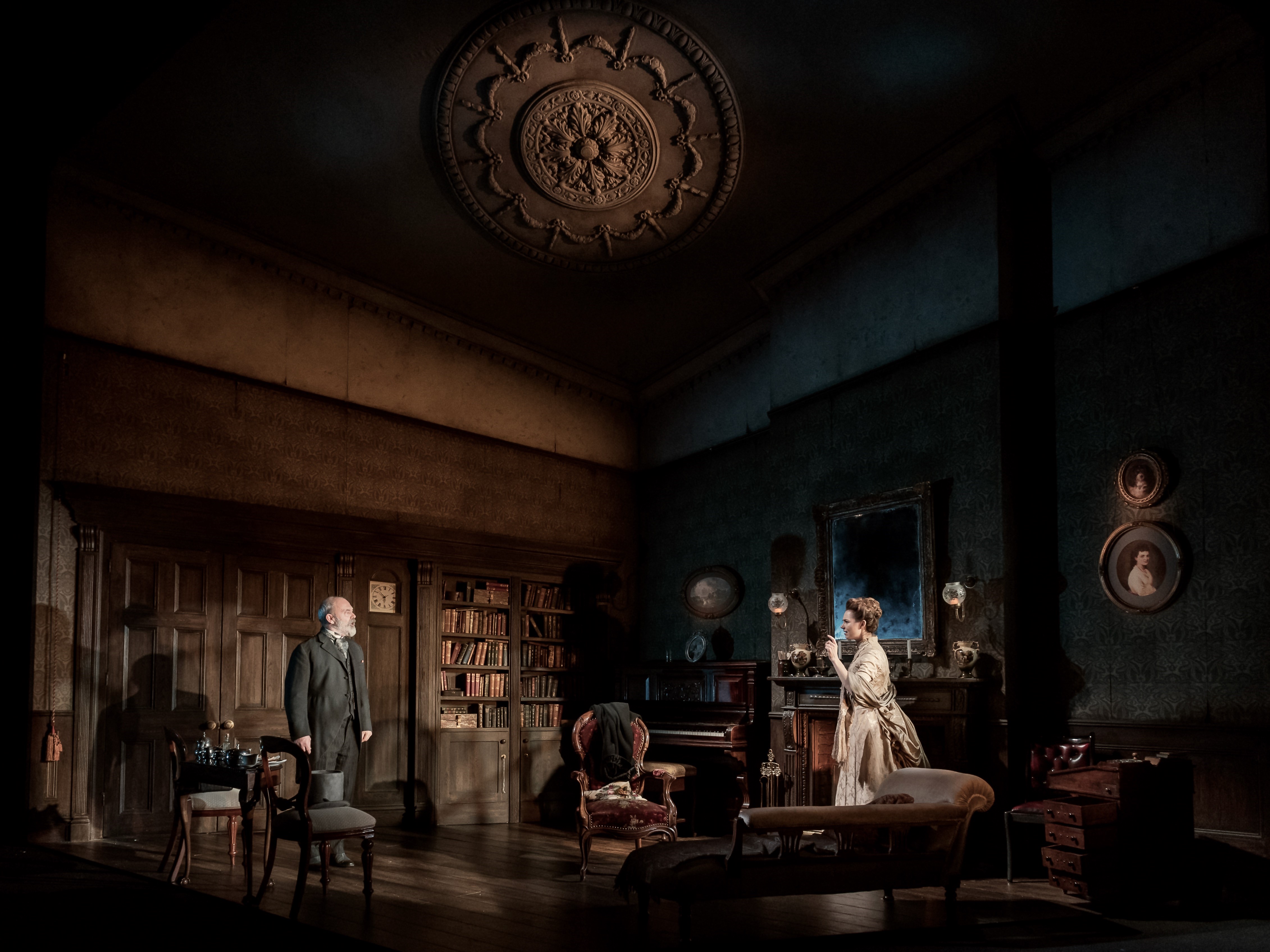 Now considered to be a theatrical classic, Patrick Hamilton’s Gaslight is currently being revived for a UK tour. The Victorian thriller opened last week at Birmingham’s New Alexandra Theatre and is now visiting venues across the UK. As one of the leading lighting suppliers to UK touring theatre, White Light was called upon to provide the lighting equipment for this production.
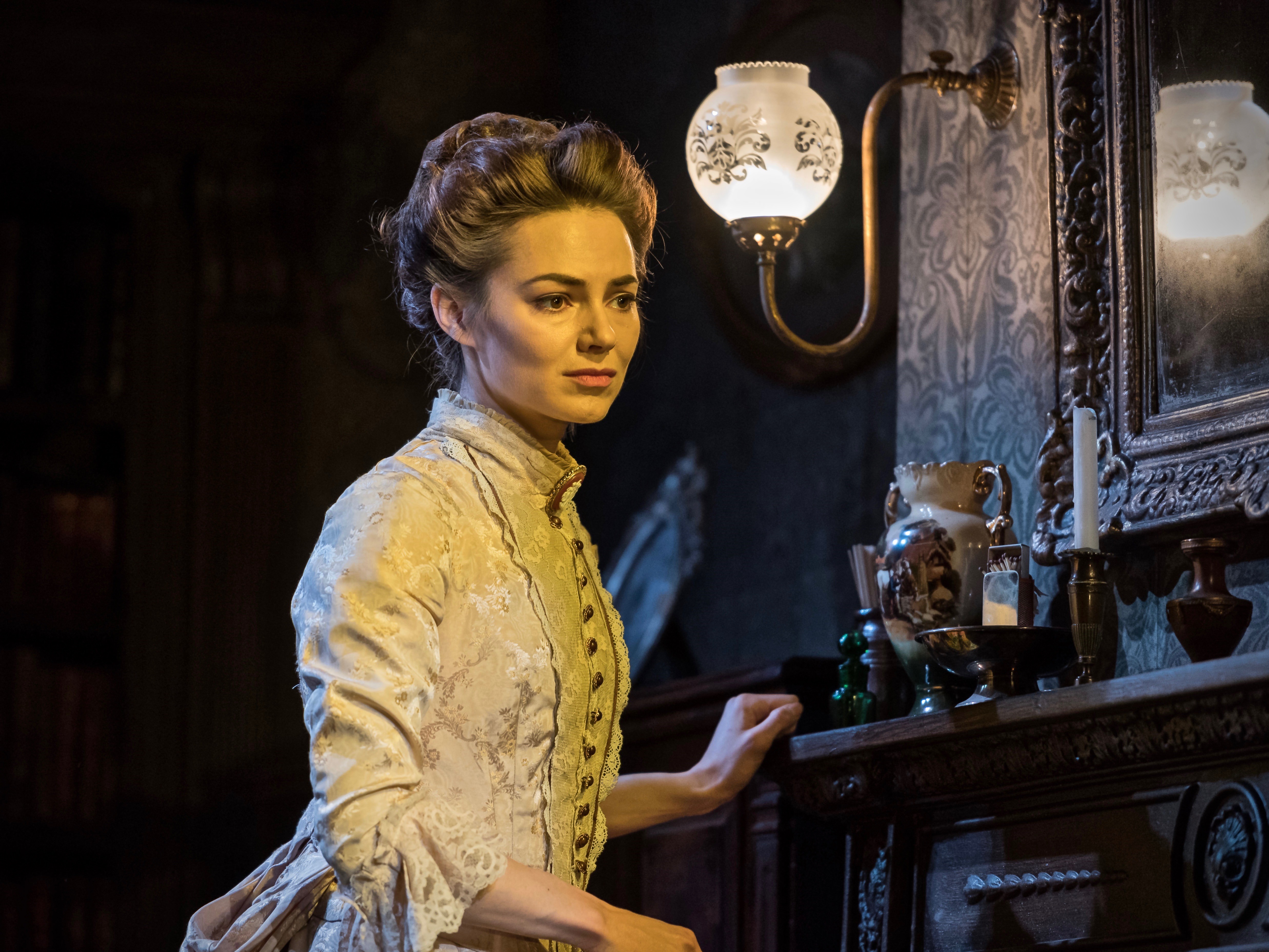 Alongside creating this gaslighting effect, Howard had to create a rig that was suitable for touring. To do this, he drew on a range of predominantly LED equipment taken from WL’s extensive inventory. This included ETC Source 4 Series 2 Lustrs, ETC Revolutions, a host of ETC Source Fours and an ETC Ion 1K Console.
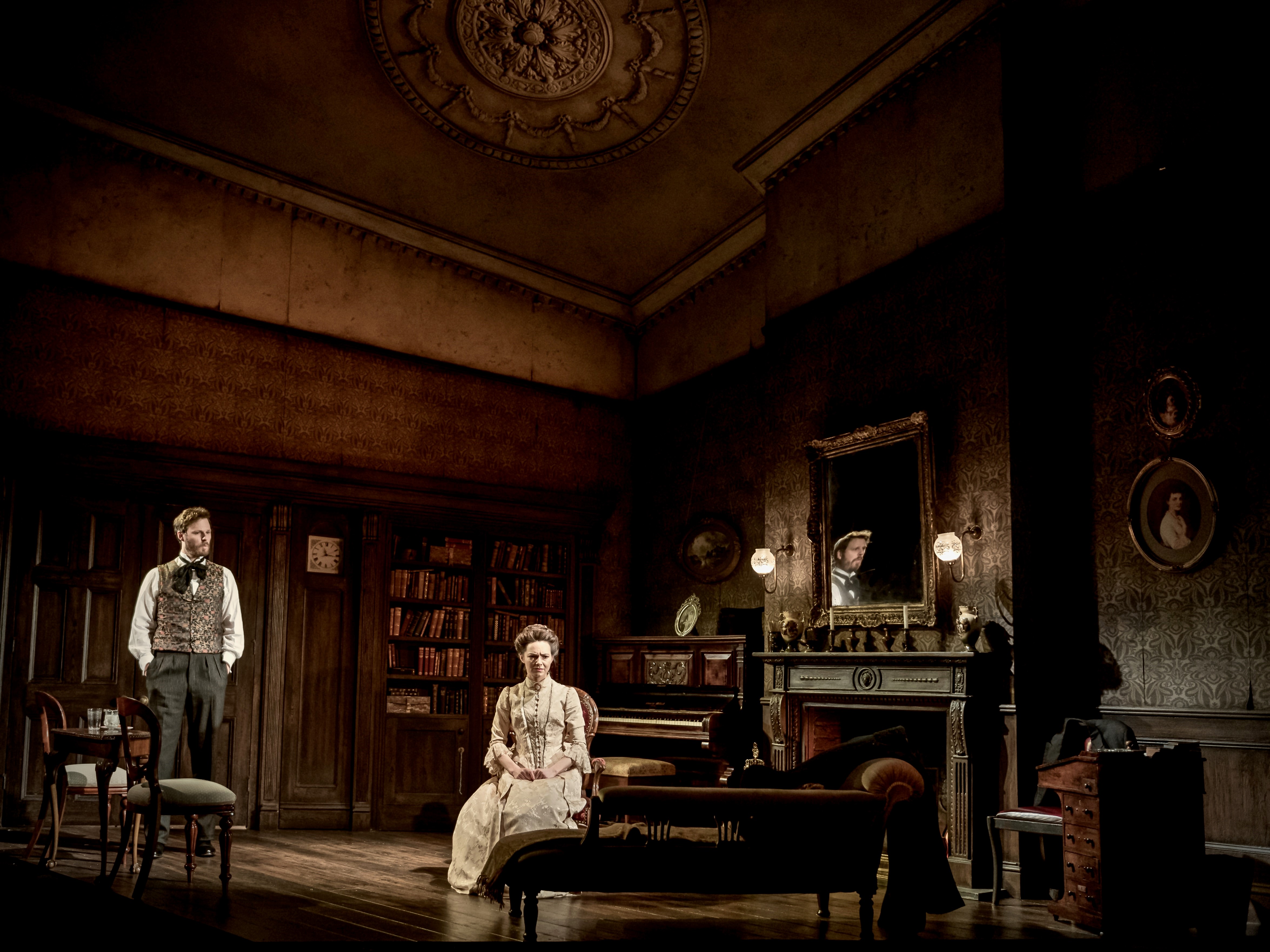 Gaslight has now opened and already received four and five star reviews from The Telegraph, The Times and WhatsOnStage to name but a few. The play is currently playing at the Aylesbury Waterside Theatre before visiting Woking’s New Victoria Theatre (23 – 28 Jan), York’s Grand Opera House (30 Jan – 4 Feb), Brighton’s Theatre Royal (6 – 11 Feb) and Richmond Theatre (6 – 11 March).