The Lyric where James’ Production Management career began (and ended!).
The year was 1998 and, after three years at Nottingham Playhouse, James had started operating and plotting shows at the venue (“I was starting to find my feet”). However, as soon as James was settling, external factors would once again intervene: “My then girlfriend had just got a job at Birmingham Rep so she was set to leave Nottingham. At the same time, I received a phone call from the actor who had been the Dame in the Panto that year, Mark Chatterton . He was about to direct a show for LipService Theatre Company called King Arthur and the Knights of the Occasional Table. He asked if I’d be interested in relighting the tour.” James took the role and found himself travelling back and forth across the country. He states: “Relighting was another great opportunity to learn. We were doing one night stands in a huge variety of small scale venues. Some were little more than cowsheds, and often the lighting needed a lot of adaptation. I had to be inventive to preserve the spirit of the design. Very often I couldn’t fully recreate it. As I’d had no formal training as such, this really helped me understand why designers did what they did. There was a lot of trial and a lot of error but it was invaluable training”. LipService also took James on an Arts Council tour of Pakistan, “but that is another story entirely…”.
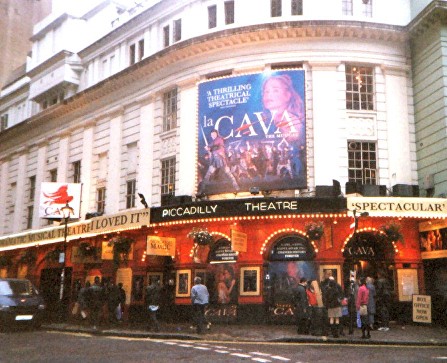
La Cava on which James assisted Chris Ellis
The tour finished and James found himself in the world of freelancing. Yet he was soon to step directly into another role: “I landed a job with Pilot Theatre Company in York. They had just finished a tour of Lord of the Flies and were looking for a Production Manager and someone to relight their second tour. It was a highly successful show, touring midscale venues across the UK, and represented a good progression for me. The tour ended at the Lyric Hammersmith in London”. It was at this point that James was rethinking his career path: “I was struggling to get enough work, and I thought being a production manager might be a useful string to my bow”.
So with the tour finished, James decided to stay in London. His brother was a student at Goldmith’s (where Lighting Designer Paule Constable studied – you can read her Leading Light here) and “he let me sleep rent-free in the cellar of his shared house in New Cross. I stayed much longer than originally intended”.
Having decided to pursue work as a production manager and having made contacts at the Lyric Hammersmith, James worked there on a show by The Right Size; a devised piece called Bewilderness: “It was a useful experience – in the sense that it taught me that I absolutely hated being a production manager! That show was hugely inventive and very challenging, but it almost finished me. It was my last job ever as a PM”. However, James eventually went on to work happily as LD for one half of The Right Size, Sean Foley, on several shows, including the Ladykillers and Jeeves and Wooster in the West End.
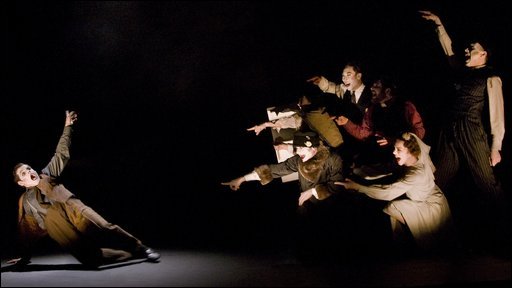
The Overcoat was one of James’ first big successes.
It was during these early days in London that James would start working as assistant to lighting designer Chris Ellis: “Chris was a big influence. He can be a fierce man and very business-like. He gave me a lot of work and taught me a lot. My first experience of the West End came from him. I was his assistant on La Cava which played at the Victoria Palace and then Piccadilly Theatre and was produced by Barbara Broccoli. Lighting aside, it was my first introduction to the politics of commercial theatre and managing the intervention of producers and so forth. Chris was passionate about his work and always determined to make the best show possible. He also put a lot of store by his team; the programmer, the production electrician, the DSM. He showed me what lighting design really entails, that it is very much a collaboration, relying on diplomacy, patience and the skill of a great many people. He also gave me a lot of confidence, encouraging me to have an opinion, to voice my ideas. He came to see my early work and his enthusiasm and evident pride in me were significant factors in my decision to pursue lighting as a career”.
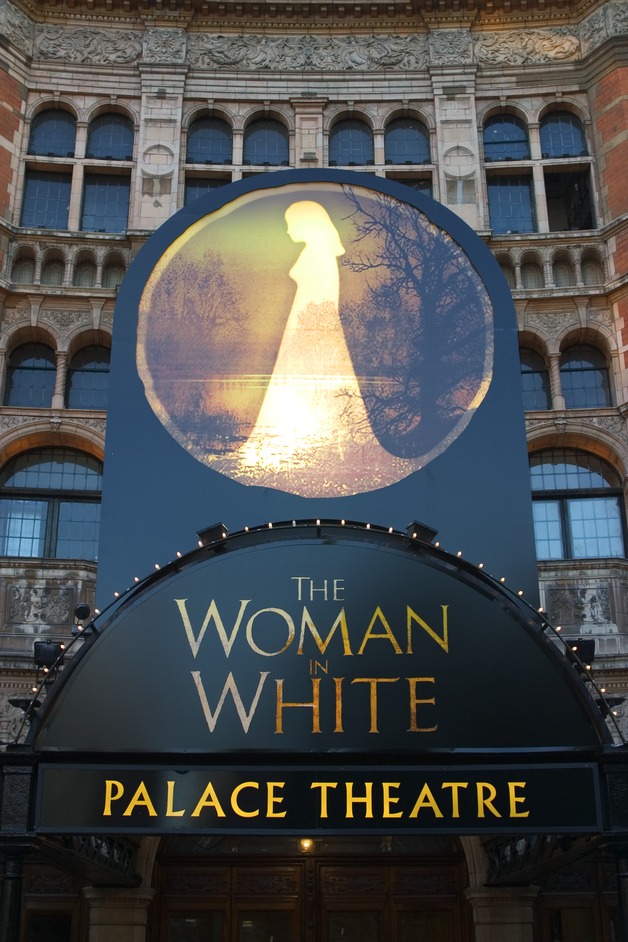
The Woman in White is the only professional collaboration James has with his uncle.
The year was now 2002 and James was contacted by Marcus Romer, the Artistic Director of Pilot, in what would turn out to be another fortunate intervention: “Following Lord of the Flies, Marcus had been offered a show at the Worcester Swan. It was a stage adaptation of The Elephant Man and he asked if I would be interested in lighting it. I said yes of course and I’m so glad I did. It was a tiny show in a tiny theatre, but it was a huge turning point. I started noticing the play of light everywhere”.
Following his work on The Elephant Man, James immediately went to work on Pilot’s next show, Rumblefish. He comments: “It’s that vicious cycle: you don’t get work until you’ve done work. But from that point on, I almost became Pilot’s default lighting designer. It meant people were starting to see my work”.
Alongside a fledgling design career, James continued working as assistant, most notably to Paul Pyant on Andrew Lloyd Webber’s The Woman in White: “It remains our only professional collaboration to date. I called the four followspots – they were hilarious! The things I learnt on that followspot ring…there was probably as much drama on cans as there was onstage!”.
Another regular role for James was at the Ipswich Wolsey Theatre. Here he met Pete Rowe, the Artistic Director: “Similar to Marcus at Pilot, I got on well with Pete – so much so that for a while I was the regular LD at the venue. I lit everything from Pinter to the Panto (I don’t think there was actually a Pinter, but you get the idea…)”.
There followed a long period, the best part of ten years, in which James worked up and down the country in regional repertory theatre including Nottingham Playhouse, Birmingham Rep, Leicester Haymarket, Scarborough Steven Joseph, Ipswich Wolsey, Exeter Northcott, Northampton Theatre Royal, Watford Palace and York Theatre Royal: “It was part livelihood, part apprenticeship, part endurance test. It was also an invaluable time. But I was never at home, and now I can’t abide a Virgin Pendolino”.
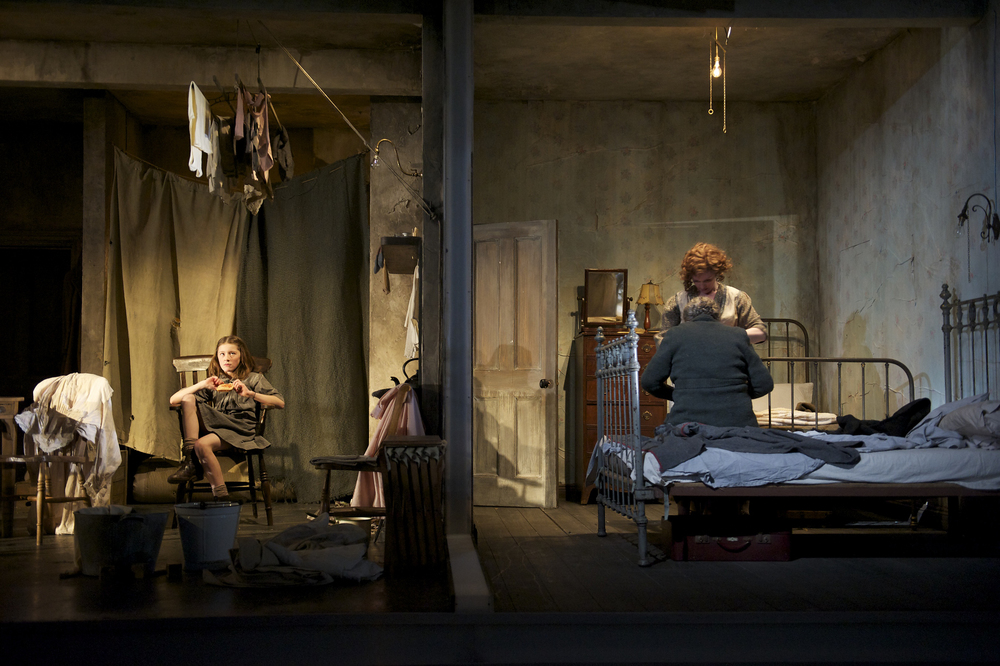
Men Should Weep, which was directed by Josie Rourke, marked James’ National Theatre debut.
Pete Rowe put James in touch with Amit Lahav of Gecko who asked him to light their next show, The Overcoat. It toured before coming to the Lyric Hammersmith: “There was a buzz around Gecko and lots of people were coming to see it in London. I remember Nick Hytner and Tom Morris coming along. Paule Constable was particularly complimentary and has remained a generous champion of mine. It felt like people were finally recognising my work”. This was seemingly true, with Lynn Gardner noting “James Farncombe’s exquisite use of light and shadow is a show in its own right”.
The show marked the beginning of James’ recognition as an emerging lighting designer: “It felt like long time coming, but when the break finally happened, things moved quickly. I had lit for Josie Rourke at the Bush Theatre and suddenly she was directing Men Should Weep at the National – which she asked me to light. This was a big moment in my career. I had wanted to work at that venue for ten years, but never came close. The set, designed by Bunny Christie, was beautiful but challenging to light. That said, I got on the right side of Laurie Clayton and Simon Fraulo, resident wizards of the Lyttelton lighting department, and with their colossal expertise and patience, we found a way through. It really pushed me, but was actually a real joy to work on. It gave me confidence and it opened a lot of doors”.
Following his National debut, James found himself in demand. Looking over his impressive CV, I inquire as to whether he has any favourite shows. Naturally, he doesn’t have just one: “Juno and the Paycock for the late, great Howard Davis was particularly memorable. I remember seeing Howard’s work when I first came to London, and thought, I’d like to work with someone like him one day. A decade later I found myself in pre-production meetings for Juno sat opposite him. People for Nick Hytner which was written by Alan Bennett and it was just magic to be in the room with that brilliant man. The Ladykillers was also a memorable production. It ran at the Gielgud in the West End, and was the first time I opened a royalty cheque and thought there must be a typo – too many noughts (that doesn’t happen very often!). I love working with Katie Mitchell and my favourites would be Pelleas et Melisande at the Aix-en-Provence International Festival and recently Anatomy of a Suicide at the Royal Court. Other highlights include People, Places and Things and London Road in the Olivier. And we haven’t even really started talking about the opera…”
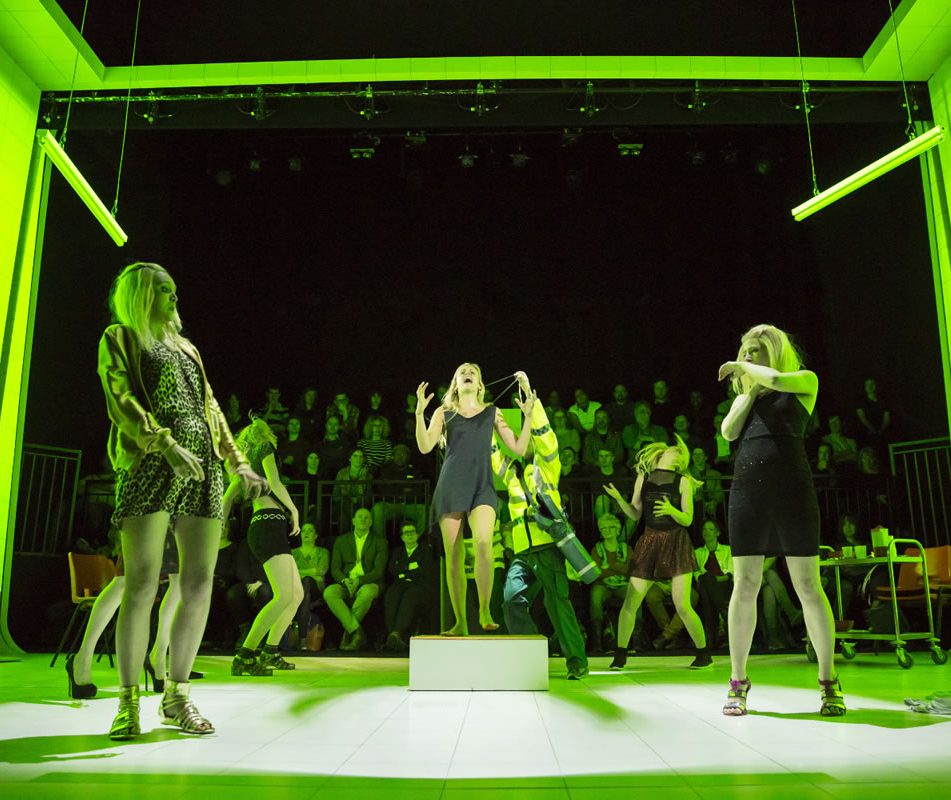
People, Places and Things which James lit at the National and transferred to the West End. It is now on tour and about to transfer to Broadway.
So the time has come where I ask James that well-known question: what advice do you have for the next generation of lighting designers? James’ answer is actually both thoughtful and realistic: “Do your time. This industry is all about patience and climbing the ladder. You might spend years freelancing, relighting and probably doing jobs that you’d rather not. That said, working in different departments and knowing about all areas of the profession can’t be a bad thing.
“I also think it’s important to learn to say no. If you’re a freelance designer, you need to learn how to say no to certain projects and make intelligent decisions when it comes to your work. Mainly so you can do the job properly but also for the sake of your sanity and your integrity – not to mention your general health”.
James is also quick to remind me how, whilst theatre is his biggest passion, time away from the industry is vital. He comments: “You need to find something to do away from lighting. For me, I’m still love making music and I still write songs and play the piano. I’m also learning French at the moment. I can spend hours getting lost around art galleries too”. However, there is one other thing that’s keeping James extremely busy at the moment: “I’m now a dad. Having my daughter means I strive for a more healthy work/life balance, and she is my saving grace. She says one day she is going to come and ‘work in the dark with me’… I still work too much, but I’m slowly learning to get my priorities in the right order”.
And with the emergence of the next generation of the Farncombe family, it remains to be seen as to whether this theatrical family will produce yet another lighting designer…
Photos courtesy of BBC TV, Dan Wooler, David Baird, Manual Harlan, Nottingham Trent University, Paul Pyant, Richard Haughton, Stephen Keeling and Tom Lancaster.
We use cookies on our website to give you the most relevant experience by remembering your preferences and repeat visits. By clicking “Accept All”, you consent to the use of ALL the cookies. However, you may visit "Cookie Settings" to provide a controlled consent. View our View our Privacy Policy
This website uses cookies to improve your experience while you navigate through the website. Out of these, the cookies that are categorized as necessary are stored on your browser as they are essential for the working of basic functionalities of the website. We also use third-party cookies that help us analyze and understand how you use this website. These cookies will be stored in your browser only with your consent. You also have the option to opt-out of these cookies. But opting out of some of these cookies may affect your browsing experience.
Necessary cookies are absolutely essential for the website to function properly. These cookies ensure basic functionalities and security features of the website, anonymously.
Cookie
Duration
Description
cookielawinfo-checkbox-analytics
11 months
This cookie is set by GDPR Cookie Consent plugin. The cookie is used to store the user consent for the cookies in the category "Analytics".
cookielawinfo-checkbox-functional
11 months
The cookie is set by GDPR cookie consent to record the user consent for the cookies in the category "Functional".
cookielawinfo-checkbox-necessary
11 months
This cookie is set by GDPR Cookie Consent plugin. The cookies is used to store the user consent for the cookies in the category "Necessary".
cookielawinfo-checkbox-others
11 months
This cookie is set by GDPR Cookie Consent plugin. The cookie is used to store the user consent for the cookies in the category "Other.
cookielawinfo-checkbox-performance
11 months
This cookie is set by GDPR Cookie Consent plugin. The cookie is used to store the user consent for the cookies in the category "Performance".
viewed_cookie_policy
11 months
The cookie is set by the GDPR Cookie Consent plugin and is used to store whether or not user has consented to the use of cookies. It does not store any personal data.
Functional cookies help to perform certain functionalities like sharing the content of the website on social media platforms, collect feedbacks, and other third-party features.
Performance cookies are used to understand and analyze the key performance indexes of the website which helps in delivering a better user experience for the visitors.
Analytical cookies are used to understand how visitors interact with the website. These cookies help provide information on metrics the number of visitors, bounce rate, traffic source, etc.
Advertisement cookies are used to provide visitors with relevant ads and marketing campaigns. These cookies track visitors across websites and collect information to provide customized ads.